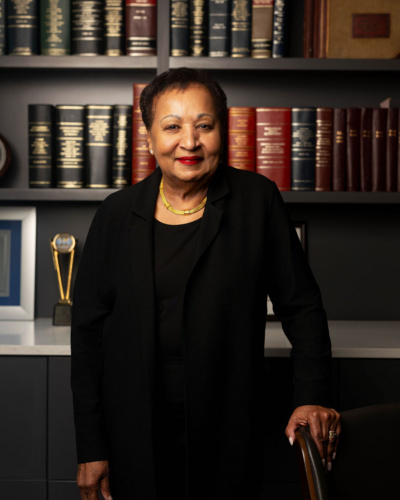
World Trade Center Savannah Chairperson and Savannah Economic Development Authority Vice Chairperson Joyce Roché broke barriers when she was named Avon’s first African American female Vice President and later served as President and COO of Carson Products Company. She also served as President and CEO of Girls Incorporated, a national nonprofit focused on research, education and advocacy for girls, and is the author of The Empress Has No Clothes…Conquering Self-Doubt to Embrace Success, a memoir about overcoming imposter syndrome.
In honor of Black History Month, we asked Joyce to share some words of wisdom and advice.
1. As a leader with experience across corporate, nonprofit and board service, when did you first begin to see the broader impact your work could have on the people and communities around you?
The first time I realized the impact my work was having on others was when I left Carson Products and decided to take some time to think about my next career move. During that time, I decided to do a few projects for some nonprofit organizations whose boards I served on here in Savannah. While throughout my
career I was on the board of nonprofit organizations, I never really felt I had time to do anything of substance for them, so I decided during this break, and as I made decisions about my career, I would really do something for these organizations. I was on the board of Savannah on Stage (the predecessor to the Savannah Music Festival) and the American Diabetes Association, so I worked on a marketing plan for Savannah on Stage and on hiring a PR firm. I did some work for the American Diabetes Association and a media campaign for my church. While I was doing this work, I felt that I was only using a small piece of my experience and a small part of my skill set, yet it was having a major impact on these organizations, primarily because they did not have the time or the resources to engage in these types of efforts.
This was an aha moment for me because while I was looking at several new corporate opportunities, I seemed to have concerns with each one (not the right location, not the right culture, not challenging enough), so I realized that I wanted something different at that point in my career. While I loved my corporate career and had been quite successful in it, it wasn’t fueling a need I was beginning to have: to do something that would have a positive impact on others, not just make money. That is when I decided to make a major career change, leaving Corporate America and moving to the nonprofit sector. This led me to decide to become the CEO of Girls Incorporated and to move back to N.Y.
2. Who helped open doors for you along the way, and how has that shaped the way you lead others today?
Actually, it was not a who but a what that opened doors and that was the Civil Rights Movement. As a result of those who sacrificed so much, doors were open to me, like being accepted to Columbia Business School, when I never thought that was a possibility. The Business School introduced me to Marketing as a career, a career path I didn’t know existed but loved from the day I took my first marketing class, and that led me to a career that was more than I ever could have imagined. When I began in my first marketing job at Avon, I was lucky enough to have bosses who did not limit me, but seemed to say, ‘Let’s see what she can do,’ and gave me opportunities to demonstrate my abilities rather than say, ‘I don’t know if she is able to do this.’ While I worked hard and achieved the goals set, without these folks giving me the opportunities, I would not have achieved the success I did. Throughout my career, I have tried to do the same for those who worked for me. I realized early on that you never know what package talent will come in, so you need to give others the opportunity to show what they can do and provide guidance and encouragement to help them succeed.
3. While writing The Empress Has No Clothes: Conquering Self-Doubt to Embrace Success, what surprised you most about your own journey once you had the chance to reflect on it?
In writing my book, The Empress Has No Clothes, I recognized for the first time that whenever I was given a new opportunity, self-doubt drove me to work like crazy and to feel I had to prove I deserved it rather than enjoy the journey.
4. Many emerging leaders feel pressure to prove they belong before speaking up. What experiences helped you learn when to trust your voice, even in unfamiliar or high-stakes environments?
Early in my career, I was terrified that I would say the wrong thing and appear to others that I didn’t belong in the room and had nothing to contribute to the discussion. So, I would sit back and think about my answer and mentally cross all the “t’s” and dot all the “i’s” until it was perfect before I would let it out of my mouth. But after a few times of sitting back and hearing someone, usually a guy, say what I had been thinking 5 or 10 minutes before, I realized that by sitting back and not speaking up, I was giving credence to the fact I did not know the answer, or did not have enough experience or smarts to contribute to the discussion, so I needed to risk being wrong, trust my experience and speak up.
5. From your perspective, what responsibility do senior leaders have to address workplace culture when self-doubt is rooted in environmental barriers rather than individual confidence?
I believe it is critically important for leaders to create a workplace environment that allows folks to feel they can take risks, think differently, and contribute otherwise, you miss valuable new ideas and aren’t fully using the talent within your organization.
6. During Black History Month, what lessons from your leadership journey feel most important to share with the next generation of Black professionals?
The first lesson I would say to the next generation of Black professionals or anyone beginning on their career path is to trust your abilities and not allow what you think others may be thinking about you (you are not smart enough, not experienced enough, did not go to the right school,…) to prevent you from pursuing your goals. I would also say learn to internally validate yourself and not always look for external validation to know that you are ready. Finally, I would say as I said in my book, ‘Remember you desire a place at the table.’